Ai2's HiRO-ACEv2 generates global 3 km extreme-weather data at about 1/300th the cost of a physics model
Ai2 released HiRO-ACEv2 on Hugging Face, pairing its ACE climate emulator with an upgraded HiROv2 downscaler that predicts rain, wind and pressure at 3 km resolution. The models, tutorial notebooks and a web demo are available.
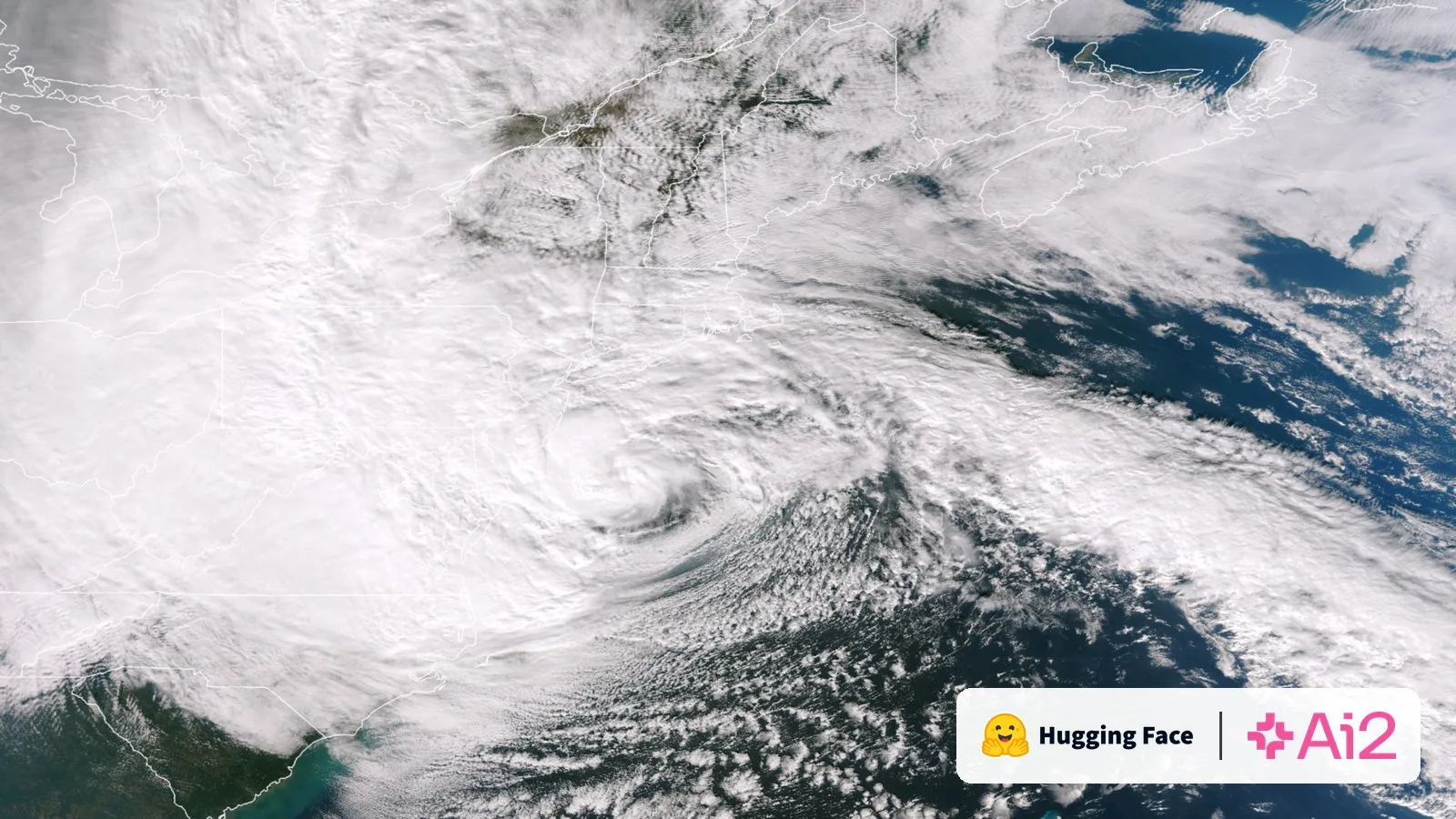
Image: NOAA/NESDIS Environmental Visualization Laboratory via Wikimedia Commons (public domain; GOES East image of Hurricane Sandy, 2012). Hugging Face and Ai2 logos via Wikimedia Commons (public domain).
Ai2 introduced HiRO-ACEv2 on the Hugging Face blog on October 14, the newest update to its High Resolution Output Ai2 Climate Emulator. The system has two parts: ACE, an AI model that runs at a coarse 100 km resolution, and HiRO, which sharpens those outputs into 3 km detail. The biggest change is the new downscaler, HiROv2, which can now predict several high-resolution fields at once instead of just rainfall and has improved skill on extreme events.
When given coarsened data from X-SHiELD, a high-resolution global atmospheric model that explicitly simulates storms, Ai2 says HiROv2 matches the target simulation's high-resolution statistics to within 3%, even for events that occur only once in a million data points. It says the model accurately estimates the total energy of tropical cyclones, including storms it never saw in training, and generates hurricanes with realistic eyes and rain bands, though winds and pressure around the eye remain somewhat more lopsided than in X-SHiELD.
Combining HiROv2 with an updated ACE, Ai2 generated a full year of global 3 km data whose statistics closely match X-SHiELD's, and a 10-year run with comparable hurricane energy. Ai2 says producing global high-resolution data this way costs roughly 300 times less than running X-SHiELD, with savings more than a hundred times greater when only one region is needed, and that a streamlined HiROv2 could be more than ten times faster still. These are Ai2's own results.
Ai2 notes that because HiRO learned from X-SHiELD, it only works with the version of ACE tuned to match it, so it cannot yet produce high-resolution data for other climates such as a warmer future or the historical ERA5 record. It plans to train on new X-SHiELD datasets, including one simulating a world 4°C warmer, and to add outputs such as near-surface temperature and snow and ice. The models can be downloaded alongside tutorial notebooks and a web demo comparing HiROv1 and HiROv2 with X-SHiELD.